 Affordable and attainable housing for people with various income levels and needs is key to a vibrant, healthy, and resilient region. Cape Cod is facing a significant challenge in providing affordable and attainable housing for current and future Cape Cod residents. This impacts not only those seeking housing but also our economy, as employers may struggle to find employees locally. The region’s highly constrained housing market is unaffordable to many Cape Cod residents; a problem which has only become more acute over the past few years as home prices have increased significantly.
Completed in 2024, the Cape Cod Regional Housing Strategy addresses the housing supply, affordability, and availability issues facing the region by identifying appropriate areas for housing development and redevelopment and crafting policies and strategies to further its goals. The strategy identifies key regional challenges to providing affordable and attainable housing for current and future Cape Cod residents. Among these challenges are the high household income (more than $210,000) necessary to afford the median-priced home for sale, the gap between that income needed and the median household income, the growth of sales prices outstripping growth in income, profitability of short-term rentals versus long-term rentals, and the difficulties year-round renters and homebuyers have finding available housing. The Regional Housing Strategy identifies several guiding principles for the strategy, including the need to support year-round residents. To help address the key challenges facing the region, the strategy provides 13 regional recommendations, one of which is to "provide financial incentives to convert and preserve year-round housing."
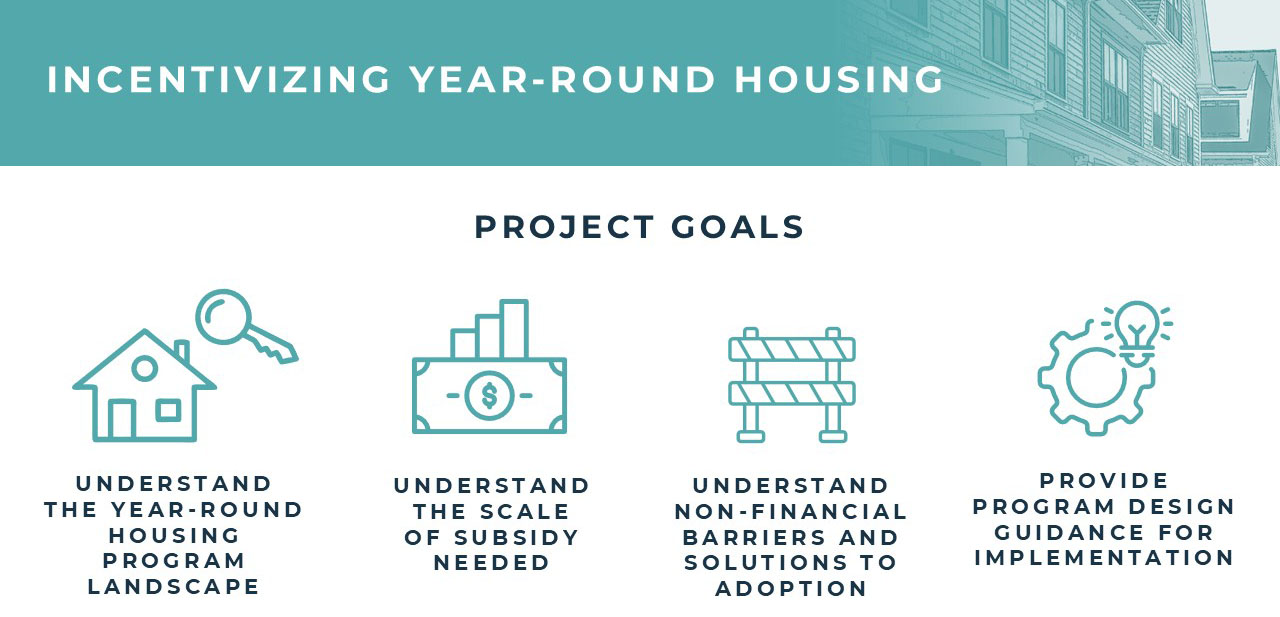
To advance this recommendation, the Commission contracted with consultant Outwith Studio with funding provided through the Massachusetts Executive Office of Housing and Livable Communities' District Local Technical Assistance program to research the structure and implementation of year-round incentive programs nationally. The report provides an overview of the year-round incentive program landscape; helps to give a sense of the scale of subsidy needed for such programs on Cape Cod; identifies what some of the non-financial barriers and solutions to implementation and program participation; and provides program design guidance for potential implementers.
This research project focused on two types of incentives for year-round housing: deed restrictions and recurring rental subsidies. The research team used documentary research methods to understand the broad national landscape and interviewed a subset of program administrators to glean nuances in program implementation and change over time. The team also interviewed local government officials, real estate professionals, and homeowners working on Cape Cod to understand the goals, desires, and perceived constraints to adoption and participation. This qualitative work is complemented with quantitative and geospatial methods, which were used to address questions of subsidy scale and (sub)market nuances.
Deed Restriction Programs
In the context of this research, deed restrictions refers to permanent or semi-permanent agreements attached to the property deed that require year-round occupancy (either by owner-occupants or year-round renters). Year-round deed restriction programs work to preserve housing stock in seasonal resort communities where year-round residents and workforce are routinely priced out by the seasonal market. With these types of programs, a town or housing entity compensates a homeowner in exchange for restricting the property to year-round, primary residence use and prohibiting short-term rentals. A review of similar programs in other seasonal and resort communities found that deed restrictions are typically priced at 10 to 20 percent of a home’s value, often with a maximum incentive cap, though the programs can vary widely in terms of incentives and requirements. For Cape Cod, the report recommends a pilot program offering 16 percent of a home’s value, capped at $125,000, rather than tying payments directly to the gap between what a home costs and what a household can afford, targeting residents earning up to 150% of the Area Median Income.
Annual Subsidy Programs
Recurring rental subsidies are temporary (annual) incentives, in which a local/county government or its designee contracts with a landlord, who agrees to rent their property on a year-round basis. Annual subsidy programs are expensive and (by design) temporary. They are useful tools when anticipating more permanent additions to the year-round rental market. These programs are best stacked with other efforts, such as increasing affordable and attainable housing stock generally. The research recommends these programs are established as pilot programs with maximum rents also targeting households earning up to 150% AMI.