Honoring Black History on Cape Cod
Bringing under-represented histories to light is increasingly central to historic preservation, helping to tell a fuller, more equitable story of our communities. The Cape Cod Commission’s Under-Represented Histories StoryMap aims to broaden knowledge and understanding of the important stories that helped shape the region.
Cape Cod’s Black community has long shaped the region’s cultural, social, and economic life. Enslaved Africans were brought to the region in the 17th century, and in time, freed individuals established vibrant communities. Throughout the 19th and 20th centuries, Black residents contributed to maritime industries and civic life while facing systemic racism and segregation.
Among these history makers is Margaret Moseley, whose life and activism helped advance fair housing and desegregation efforts on Cape Cod.
Born in Dedham, Massachusetts, in 1901, Margaret attended Dorchester High School, where she was one of only two Black students in her class. Although she had many friends, she was never invited to social gatherings outside of school. These early experiences of exclusion sharpened her awareness of injustice rooted solely in the color of her skin.
After graduating in 1919, Margaret and her classmate Ruth set out to study nursing. They applied to Massachusetts General and other local hospitals, but each rejected them, stating they “did not accept colored people for training.”
Ruth went on to Freedman’s Hospital in Washington, D.C., while Margaret remained in Boston, continuing her search for work.
At twenty-one, Margaret married; a year later, she gave birth to her son, Frederick.
After returning to the greater Boston area, the growing family moved into a two-family house. Within months, the property was sold, and the new owner evicted them, claiming he “didn’t have to give a reason” and later admitting the decision was based on race.
Experiences like these fueled Margaret’s commitment to activism. In the 1940s, she co-founded a consumers’ cooperative in Boston and served on the boards of the Civil Liberties Union of Massachusetts and Freedom House in Roxbury. She was president of the Community Church in Boston and Massachusetts legislative chair for the Women’s International League for Peace and Freedom (WILPF). In 1958, when Martin Luther King Jr. visited Boston, she presented him with a check to support his civil rights work.
After moving to Cape Cod in 1961, Margaret helped form local chapters of the NAACP and WILPF and became a founding member of the Community Action Committee of Cape Cod and the Fair Housing Committee on Cape Cod.
In May 1962, Southern segregationists orchestrated a campaign known as the "Reverse Freedom Rides" to challenge Northern anti-segregation policies. They persuaded poor Black families to board buses for the North, promising jobs and housing that did not exist. When the first buses arrived in Hyannis, a quickly organized group of volunteers was there to meet them. Margaret greeted each bus and played a vital role in securing housing, food, and employment for those displaced from the South. She ensured families had groceries and personally accompanied them to stores. Friends and colleagues later recalled her courage and steady leadership during this tumultuous moment in civil rights history.
Margaret was also active in the Unitarian Church of Barnstable, where she helped found the Social Responsibility Committee and became the first woman to chair the Prudential Committee, the church’s governing body. She served on the boards of the Massachusetts Society for the Prevention of Cruelty to Children (Cape Cod section) and Elder Services of Cape Cod and the Islands.
Margaret Moseley died in 1997 at the age of 96. Her legacy lives on through the countless lives she touched and the organizations she helped build, reminding us of the enduring impact one person can have on a community.
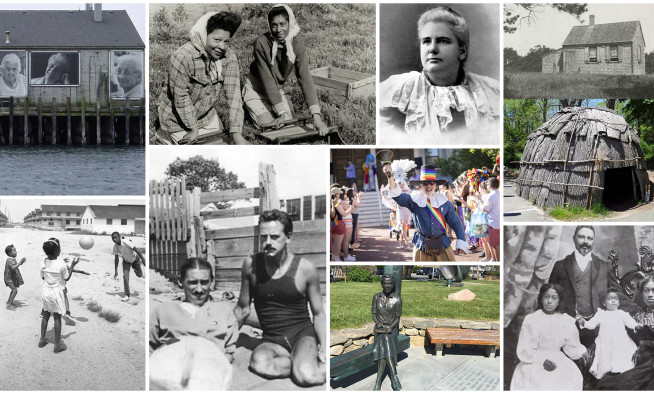
The Cape Cod Commission’s Under-Represented Histories StoryMap is an interactive online tool that elevates research led by local historians, preservation groups, museums, and community members. Through maps, images, and narratives, the StoryMap highlights five themes: Wampanoag, Cape Verdean, Black, Women’s, and LGBTQ histories.
Read more stories like Margaret’s, explore the regional map, and dive into individual sites by visiting https://cccom.link/URH.
Sources and Image Credits: Information adapted from Harvard Square Library and Wickedlocal.com. Image credits: Harvard Square Library.
Related Posts