Keyword: mpo
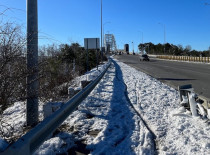
We know thousands of vehicles cross the Bourne and Sagamore bridges each day, but what about the people who don’t drive? To better understand how non-motorists are using the bridges and to plan for future needs, the Cape Cod Commission placed “eco-counters,” portable infrared sensors that detect heat to count pedestrians and bicyclists, near both the Bourne and Sagamore bridges. Data shows that hundreds of pedestrians and bicyclists traverse the canal bridges every year.
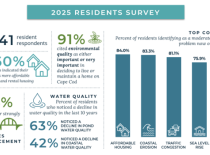
The Cape Cod Commission is in the process of updating the 2018 Regional Policy Plan (RPP), which provides regional planning which provides regional planning policies, goals, and objectives to guide development and protect the Cape’s unique natural, built, and community resources. As part of this planning process, the Commission partnered with the Donahue Institute at UMass Amherst to conduct a resident survey designed to better understand public perspectives on local and regional planning challenges. Survey results are now available.

The Cape Cod Metropolitan Planning Organization (MPO) has released the FFY2026-2030 Transportation Improvement Program and the FFY2026 Unified Planning Work Program for a 14-day public review and comment period. Members of the public are invited to review these documents and provide comments.

FFY 2025-2029 TIP Amendment #4 would remove $8,284,827 in regional target funding from the Mashpee Route 151 Improvements (Phase 2) project to reflect the current construction bid price, adjust the funding allocated to Cape Cod Regional Transit Authority budget items in FFY 2025 for facilities, vehicles, and maintenance, and remove the Harwich Safe Routes to School project from FFY 2025. View the proposed amendment at www.capecodcommission.org/mpo.
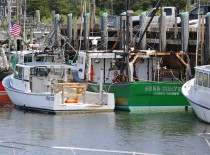
The Cape Cod Commission recently conducted an economic analysis of Rock Harbor in response to a request from the Town of Orleans. The study aimed to assess the harbor’s contribution to the local economy and to better understand visitor behaviors. Using data collected through business surveys, intercept surveys, cellphone data analysis, and economic modeling, the report sheds light on the harbor’s importance as both a working waterfront and a desirable community destination.
During a meeting held on January 27, 2025, the Cape Cod Metropolitan Planning Organization (MPO) released the Federal Fiscal Year (FFY) 2025-2029 Transportation Improvement Program (TIP) Amendment 3 for a 21-day public review and comment period.
FFY 2025-2029 TIP Amendment 3 would add a Federal Highway Administration (FHWA) Safe Streets for All supplemental planning grant in the amount of $315,000 for the Town of Barnstable to be programmed in FFY 2025. The Town will use these funds to conduct Road Safety Audits at fourteen high-crash locations in Barnstable, a project that supports the ongoing regional safety work of the Vision Zero Action Plan, an initiative under development to improve traffic safety and reduce fatalities and serious injuries region-wide.

On January 13, 2025, the CCIWPF Board voted to approve two key motions to enhance financial support for water quality monitoring programs, highlighting their connection to the Fund's mission. These programs aim to improve the understanding of both coastal and freshwater ecosystems, ensuring informed, science-based decision-making for the region.

Each year, the Cape Cod Metropolitan Planning Organization, with advisement from the Joint Transportation Committee, guidance from Cape Cod Commission transportation staff, and input from the public, helps to create the Transportation Improvement Program and Unified Planning Work Program to guide funding for infrastructure improvement projects on Cape Cod.
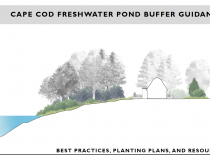
As work on the Cape Cod Freshwater Initiative nears completion, the Cape Cod Commission is pleased to present new tools and resources to support the region’s freshwater ponds.
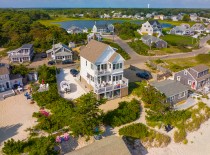
The Seasonal Communities designation recognizes Massachusetts communities with substantial seasonal variations in housing demand, visitor populations, and employment. The designation provides distinctive tools to address these unique housing needs. The law also created the Seasonal Communities Advisory Council to provide expertise on issues related to municipal government, the hospitality and tourism industries, housing law, and housing development and finance. The Council offers advice and recommendations on policies and programs tailored to the needs of seasonal communities. The Advisory Council held its first meeting earlier this month.